Tort law does not aim for maximal deterrence. It aims for optimal deterrence. In other words, not maximum deterrence, but the right level of deterrence. So what is the “optimum point” between under-deterrence and over-deterrence?
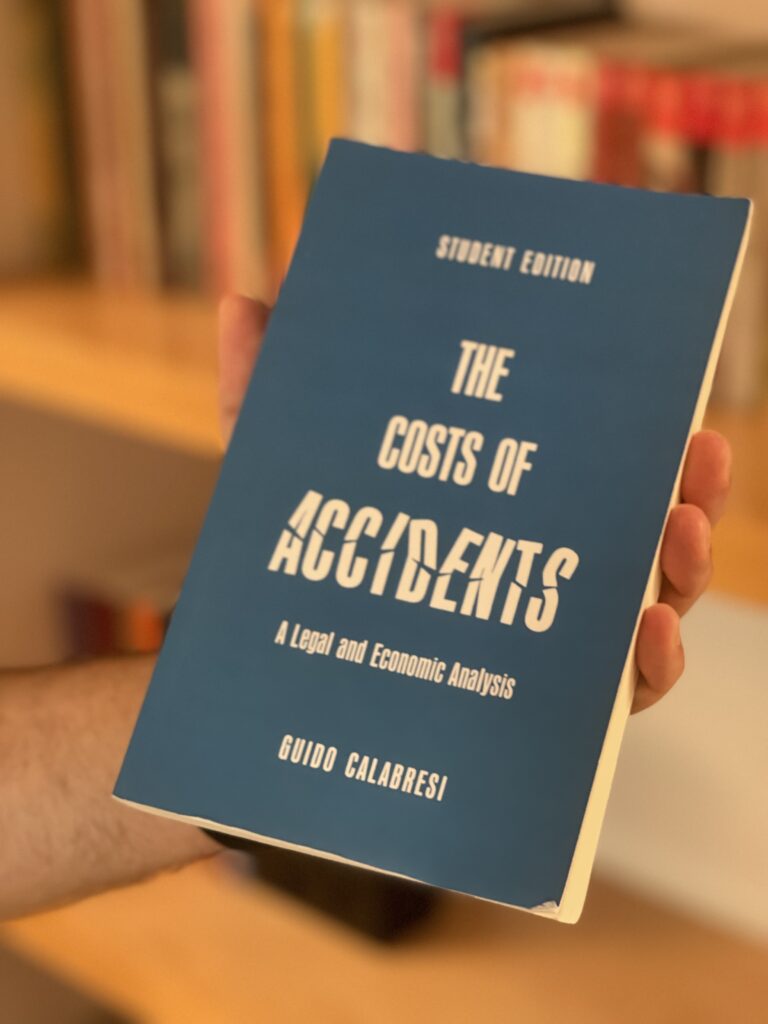
In one of the most important books ever written on tort law, The Cost of Accidents: A Legal and Economic Analysis, Professor Guido Calabresi proposed the following way to define the point we should strive for: the point at which the combined total of (1) accident costs (the social cost of accident-related harm) and (2) prevention costs (the social cost of preventing accidents and reducing the severity of harm) is the lowest.
To illustrate this idea, consider the following example.
Assume there is an especially dangerous intersection where a road crosses railroad tracks, and accidents there have caused many casualties. You are presented with three alternatives to make the intersection safer:
1) Installing a rising barrier that prevents cars from crossing while a train is passing.
2) Installing the same barrier, plus a monitor who warns drivers when a train is approaching the intersection.
3) Building a grade-separated solution, where the train passes on a bridge above the road and the road is lowered beneath it.
You are also given the following data:
|
Option B (Cost of precaution) |
PL (Expected loss if precaution is adopted) |
|
|
Rising barrier |
20 |
80 |
|
Rising barrier + monitor |
25 |
25 |
|
Grade-separated infrastructure |
100 |
0 |
B = cost of precaution (prevention measure)
PL = expected loss if the precaution is adopted
Which alternative should you choose under Calabresi’s approach?
The answer is the second alternative, because under that option, the cost of precaution plus the expected loss (B + PL) is the lowest (50).
As this shows, maximal deterrence seeks to prevent harm entirely. Optimal deterrence, by contrast, aims to bring activity to the optimum point, where additional prevention is no longer socially worthwhile.
How can we explain this? Why does tort law not seek to bring society to a state of zero harm?
One possible answer is that tort law, unlike other fields such as criminal law, often deals with accidents that arise from socially desirable activities: driving (which sometimes results in road accidents), medicine (which can sometimes result in medical accidents), and manufacturing (which can sometimes result in defective products). Maximal deterrence fits conduct aimed at causing harm. Optimal deterrence fits harms that occur as a byproduct of socially desirable conduct.
So if you have some time and feel like an intellectual treat from a true masterpiece, the book I am holding in the photo is a great choice.
Boaz